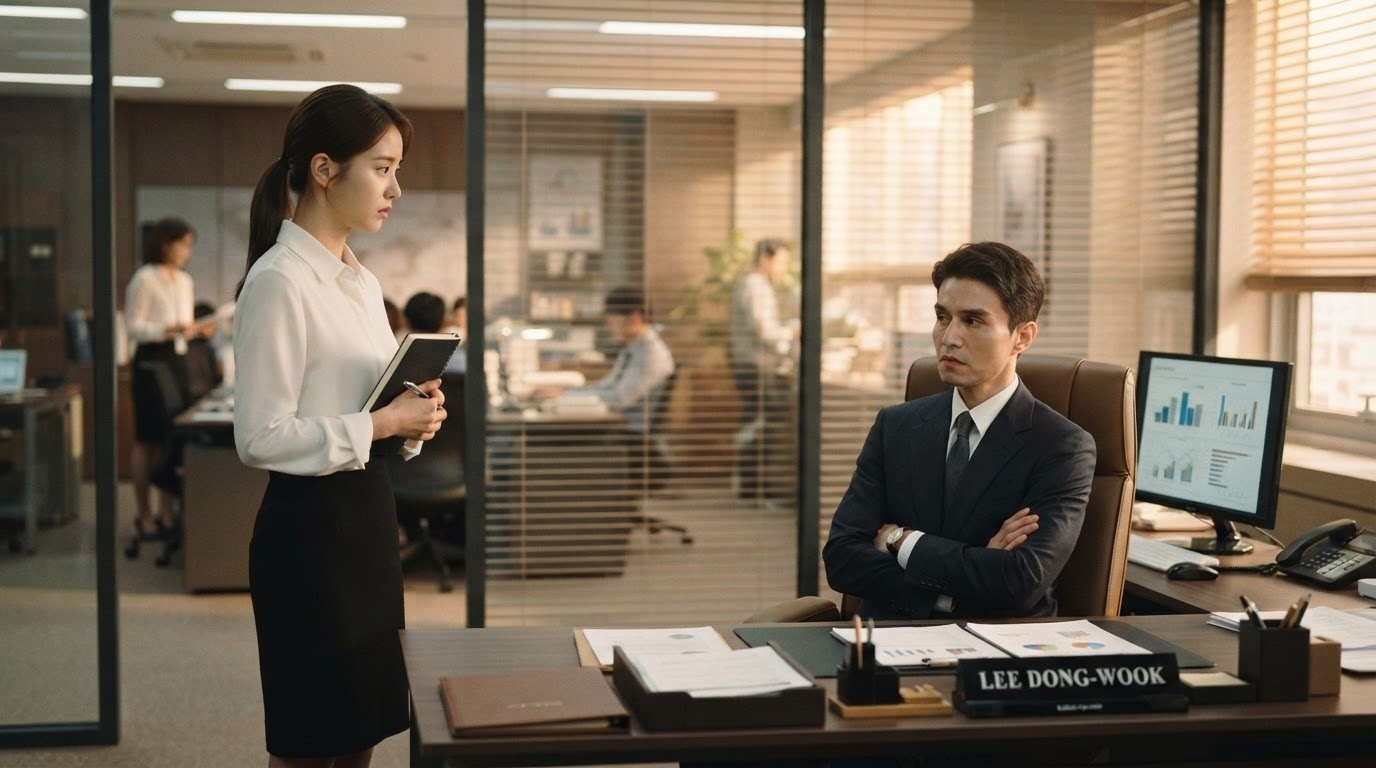
Have you ever watched a K-drama and noticed how characters seem to just know what someone else is feeling — without a single word being spoken? A junior employee senses their boss is upset before anyone says anything. A character walks into a tense room and immediately adjusts their tone. A friend knows exactly when to stay quiet instead of asking "What's wrong?" This isn't a screenwriting trick. It's a real, deeply Korean concept called nunchi — and once you understand it, an entirely new layer of Korean society will open up to you.
[What Is Nunchi?]
The word 눈치 (nunchi) combines 눈 (nun), meaning "eye," with 치 (chi), a suffix often popularly explained as relating to "measure" or "gauge" — giving the sense of "eye-measure." It's worth noting this is a widely used, simplified way native speakers describe the word's feel, rather than a strict academic etymology. What matters more is the practical meaning: nunchi is the subtle art of reading the room — sensing the mood and emotional state of the people around you, then responding appropriately, often without anyone saying anything out loud. There is no single word in English that captures this exactly; "reading the room," "social awareness," and "emotional intelligence" all overlap with it, but none fully covers it. When Koreans say someone has "눈치가 빠르다" (fast nunchi), it's a high compliment. When someone is called "눈치가 없다" (no nunchi), it's a fairly serious social criticism.
[Why Nunchi Matters So Much in Korea]
To understand why nunchi is so deeply embedded in Korean life, look at three cultural forces: hierarchy, group harmony, and high-context communication. Korea has historically been a collectivist, Confucian-influenced society where group harmony was often valued above individual expression. Speaking too directly — "I'm upset," "I disagree," "I don't want to do this" — could be seen as disruptive, especially toward someone older or higher in rank. Because direct statements were often avoided, Koreans developed a "high-context" communication style: much of the real meaning is carried by tone, pauses, and silence rather than words alone. In this environment, correctly reading what is not said became just as important as understanding what is said — and nunchi is the skill that makes that possible.
A Personal Story of Nunchi
Let me share something from my own childhood. When I was in 8th grade, I lied to my parents so I could stay out late with my friends. The moment I walked through the front door, I felt it immediately: the house was dead silent — not a peaceful silence, but the kind that feels like it's about to explode. I didn't need anyone to say a word. Just from the mood in the room and my parents' expressions, I instinctively knew: "If I make even the tiniest mistake right now, I am in serious trouble."
So instead of making excuses, I quietly walked up to them and simply said, "I'm sorry." My parents didn't scold me at all. They just told me to hurry and wash up and go to bed.
Looking back now, I think that was nunchi in its purest form — sensing everything from the silence alone, and knowing exactly what to say (and what not to say) in that split second.
[Nunchi in Real Korean Life]
At work: it's 6 PM and your shift technically ends, but your manager is still stressed about a deadline. Someone with good nunchi senses that leaving cheerfully right now would create tension, so they quietly offer help or stay a little longer. Someone with no nunchi packs up immediately — and everyone notices. In families: if a sensitive topic makes dinner tense, someone with good nunchi changes the subject without being asked. Among friends: when someone says "I'm fine" in a flat tone while avoiding eye contact, good nunchi means not taking that at face value. In public spaces: nunchi is also why Koreans instinctively form neat lines and lower their voices on public transit — a quiet system that keeps a fast-paced society running smoothly.
[Nunchi in K-Dramas vs Real Life]
If you've watched K-dramas, you've seen nunchi dramatized — a character sensing tension from footsteps alone, or an office freezing because someone realizes the boss is in a bad mood. These scenes are exaggerated for entertainment, but based on something real: Koreans are trained from childhood to read mood and unspoken hints. What's exaggerated is the almost supernatural speed of it. What's real is the constant, everyday habit of adjusting behavior based on subtle social signals.
[Good Nunchi vs No Nunchi]
Good nunchi looks like: noticing a colleague seems exhausted and quietly offering help; realizing everyone at a gathering is ready to leave and suggesting it first; understanding that "maybe next time" usually means "no." No nunchi looks like: talking loudly right as the room goes quiet; staying long after a host has hinted, "You must be tired — don't you have work tomorrow?"; pushing someone to drink more when they've clearly said no. Once someone earns a reputation for "having no nunchi," it can take a long time to be fully accepted in Korean social circles.
[Can Foreigners Learn Nunchi?]
Yes — a few practical habits help: observe before you speak; pay attention to what is NOT said; learn common hidden meanings ("괜찮아요" doesn't always mean "I'm fine"; "다음에 해요" often means "let's not"); don't rush to fill silence; ask trusted Korean friends for honest feedback. The most common mistake is applying Western "just say it directly" communication in every Korean situation — in Korea, how and when you say something matters as much as what you say.
[In One Sentence]) Nunchi is the Korean art of quietly reading people and situations, then choosing your words and actions in a way that keeps everyone comfortable.
"Have you seen this in a K-drama? Comment below!"